Galley-Smart Menus: Matching Inflight Catering to Your Aircraft Type
The most common cause of a disappointing inflight meal is not the kitchen. It is a menu that was designed without reference to the galley it had to survive. A dish that is excellent leaving a Charleston kitchen can arrive at the cabin dry, cold, or structurally collapsed simply because the aircraft it flew on had a warming drawer instead of a convection oven, or no oven at all.
Galley capability varies enormously across business aircraft — far more than most people outside the cabin realize. This guide covers what changes by aircraft class, which formats work where, and how to give your catering provider the information they need to build a menu your galley can actually deliver.
Why altitude and galley constraints both matter
Two separate forces act on inflight food. The first is physiological: at cabin altitude, with pressurization and very low humidity, perception of sweet and salty drops measurably while sour, bitter and umami hold up better. Aroma perception falls off as nasal passages dry. Food that tastes balanced on the ground can taste flat at 40,000 feet, which is why aviation kitchens season and acidify differently. We cover this in our piece on why aviation catering is different from restaurant catering.
The second is mechanical, and it is the one this guide is about: what equipment exists in the galley, how much of it there is, and who is going to operate it.
Light cabin: Citation M2, CJ series, Phenom 300, Learjet 70/75
What you have: Typically a refreshment center. Cold storage, sometimes a small warming drawer, often no oven. No dedicated cabin attendant, so anything requiring service is being handled by a passenger or, on the ground, the crew.
What works: Pre-portioned cold formats built to be excellent cold rather than tolerable cold. Substantial composed salads, grain bowls, high-quality sandwiches and wraps, charcuterie and cheese selections, crudité, fruit, and pastry. Individually sealed portions matter here because there is no space or surface for plating.
What does not: Anything requiring reheat, plating, or assembly. Multi-course service. Composed hot entrees.
The trick: Light-cabin catering is where format discipline pays off most. A superb cold offering beats a compromised hot one every time. Our FBO cheese board and crudité platter pieces cover formats built for exactly this constraint.
Midsize and super-midsize: Citation Latitude and Longitude, Challenger 350, Gulfstream G280, Praetor 600
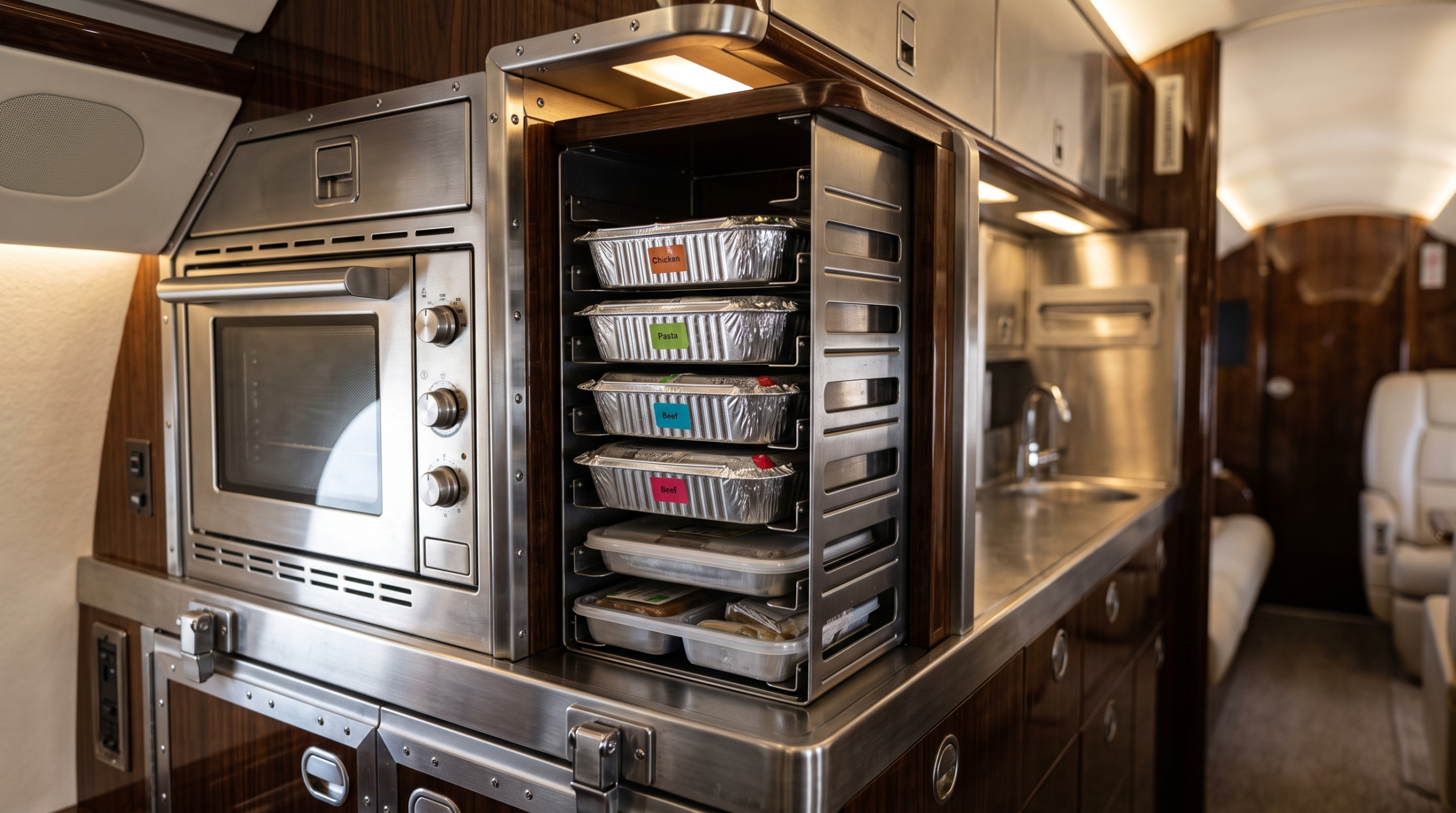
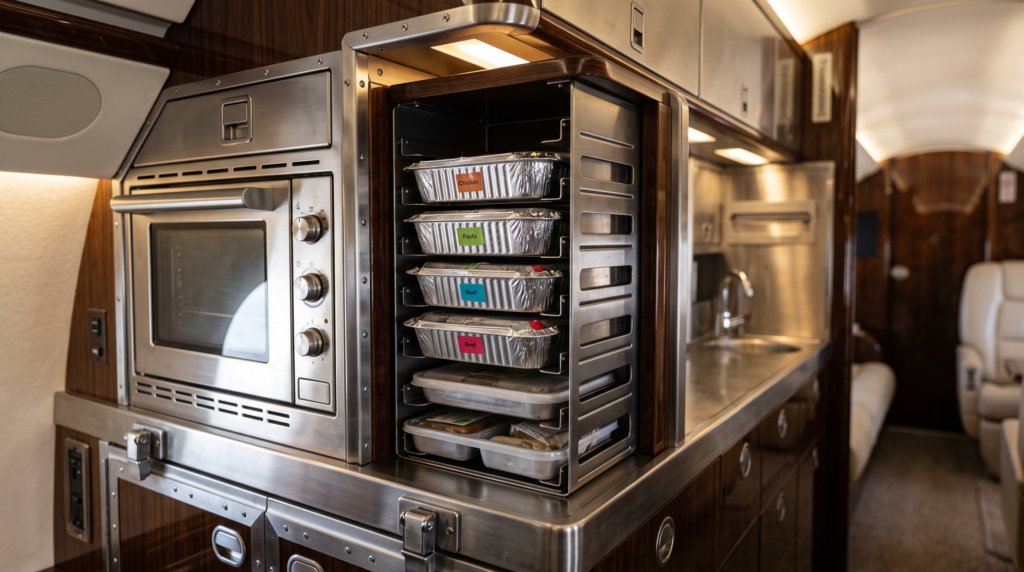
What you have: A real galley. Convection oven or high-temp warming oven, meaningful cold storage, prep surface, espresso capability on many aircraft. A cabin attendant on some trips but by no means all.
What works: This class is the sweet spot for hot food that reheats gracefully. Braised proteins, stews and curries, pasta bakes, roasted vegetables, hot breakfast items, and composed entrees supplied in oven-ready containers. Genuine two-course service is achievable when a cabin attendant is aboard.
What to watch: Oven capacity is finite and often smaller than assumed. A twelve-passenger hot service on a midsize galley may need two heating cycles, which changes service timing. Your provider needs to know the passenger count against the oven size, not just the aircraft type.
Heavy and ultra-long-range: Gulfstream G550/G650, Global 6000/7500, Falcon 7X/8X
What you have: Full galley — convection oven, steam capability on some aircraft, substantial refrigeration, proper prep space, full service ware, and almost always a dedicated cabin attendant.
What works: Essentially anything, executed as a restaurant would. Multi-course plated service, à la carte options across the passenger group, chilled seafood service, cheese and dessert courses, and wine service. This is the class where the constraint stops being the galley and becomes the lead time and sourcing — see our catering lead time guide.
What to watch: The presence of a cabin attendant changes everything about how food should be supplied. A crewed cabin wants components and plating instructions. An uncrewed heavy cabin — which does happen — wants finished, sealed portions despite the galley’s capability. Our piece on flight attendant catering covers the crewed-cabin workflow.
Turboprops: King Air 350, Pilatus PC-12
What you have: Minimal to none. Often a cooler and nothing else.
What works: Hand-held, individually packaged, ambient-stable or chilled formats. Boxed meals, wraps, substantial snack boxes. Shorter legs mean this is rarely a limitation in practice.
What to tell your catering provider
Aircraft type alone is not enough, because two aircraft of the same type can be configured differently. A complete galley brief includes:
The aircraft type and, ideally, the tail number, since galley specifics belong on the tail profile. Whether there is an oven and what kind — convection, warming, or none. Approximate oven capacity. Whether a cabin attendant will be aboard. Available service ware, or whether disposables are needed. Refrigeration volume. And the flight duration, which determines how many service events the galley has to support.
Captured once on an operator profile, this never has to be discussed again. Captured never, it gets guessed at on every order.
Packaging is the other half of the answer
Galley capability determines what can be heated. Packaging determines whether it arrives in a condition worth heating. Oven-safe containers sized to the actual oven, sauces and dressings packed separately, components that should not touch kept apart, and clear labeling that lets a crew member identify a meal without opening it — these do as much work as the menu design. Our guide to packaging for in-flight catering covers the specifics.
Build a menu your galley can deliver
If your catering consistently underdelivers relative to what you ordered, the menu and the galley are probably mismatched — and that is a fixable problem.
Request a Galley-Matched Menu — send us your fleet and galley specs, and we will build menus per aircraft so every order fits the equipment it is flying on.
More in our inflight catering services overview, our buyer’s guide to catering for private flights, and our menu. Aircraft and cabin configuration references for the broader operator community are available from NBAA.