Private Jet Crew Meals: Budgets, Duty-Day Timing, and What Flight Crews Actually Want
Private jet crew meals are the most frequently ordered and least frequently thought-about item in business aviation catering. Passenger catering gets the attention, the budget, and the menu review. Crew catering gets whatever is left over — which is exactly why it is one of the easiest places for a flight department to quietly improve crew retention, duty-day performance, and per-trip cost control at the same time.
If you are a scheduler, dispatcher, or flight department manager building a crew catering standard, this guide covers what crews actually need at each point in a duty day, how crew meal budgets typically work, and the ordering habits that keep crew food from becoming an afterthought.
Why crew meals are a different product from passenger meals
The temptation is to treat crew catering as a smaller version of the passenger order. It is not. The two have different constraints:
Crew eat on a schedule they do not control. A passenger eats when they want to. A crew member eats in the gaps — during a fuel stop, on the ground between legs, or at cruise once the cabin is settled. Crew food has to survive a variable holding window and still be good when the gap finally opens.
Crew eat one-handed and often standing. A composed plate that needs a knife, a fork, and a flat surface is the wrong format for a pilot eating in the cockpit during a turn. Wraps, grain bowls, substantial salads with protein, and hand-held items outperform anything that needs assembly.
Crew performance is a safety input. A heavy, high-fat, high-sodium meal at hour six of a twelve-hour duty day produces exactly the postprandial energy crash you do not want on approach. Crew catering that is built around steady energy — lean protein, complex carbohydrates, moderate fat, real hydration — is an operational choice, not a wellness gesture.
Crew are repeat customers. A passenger may fly with you twice a year. Your crew eat your catering forty times a year. Menu fatigue is real, and it is the single most common complaint we hear from flight departments that order the same crew sandwich tray on every trip.
What crews consistently ask for
Across years of crew orders, the requests cluster tightly:
Rotation, not variety within a single order. Crews do not need eight options per trip. They need the trip-to-trip order to change. A rotating four-week crew menu solves more complaints than an expanded single-trip menu.
Real breakfast on early departures. A 5:30 AM show time with a pastry box is a false economy. Egg-based hot items, breakfast burritos, steel-cut oats and Greek yogurt with fruit hold well and actually carry a crew to mid-morning.
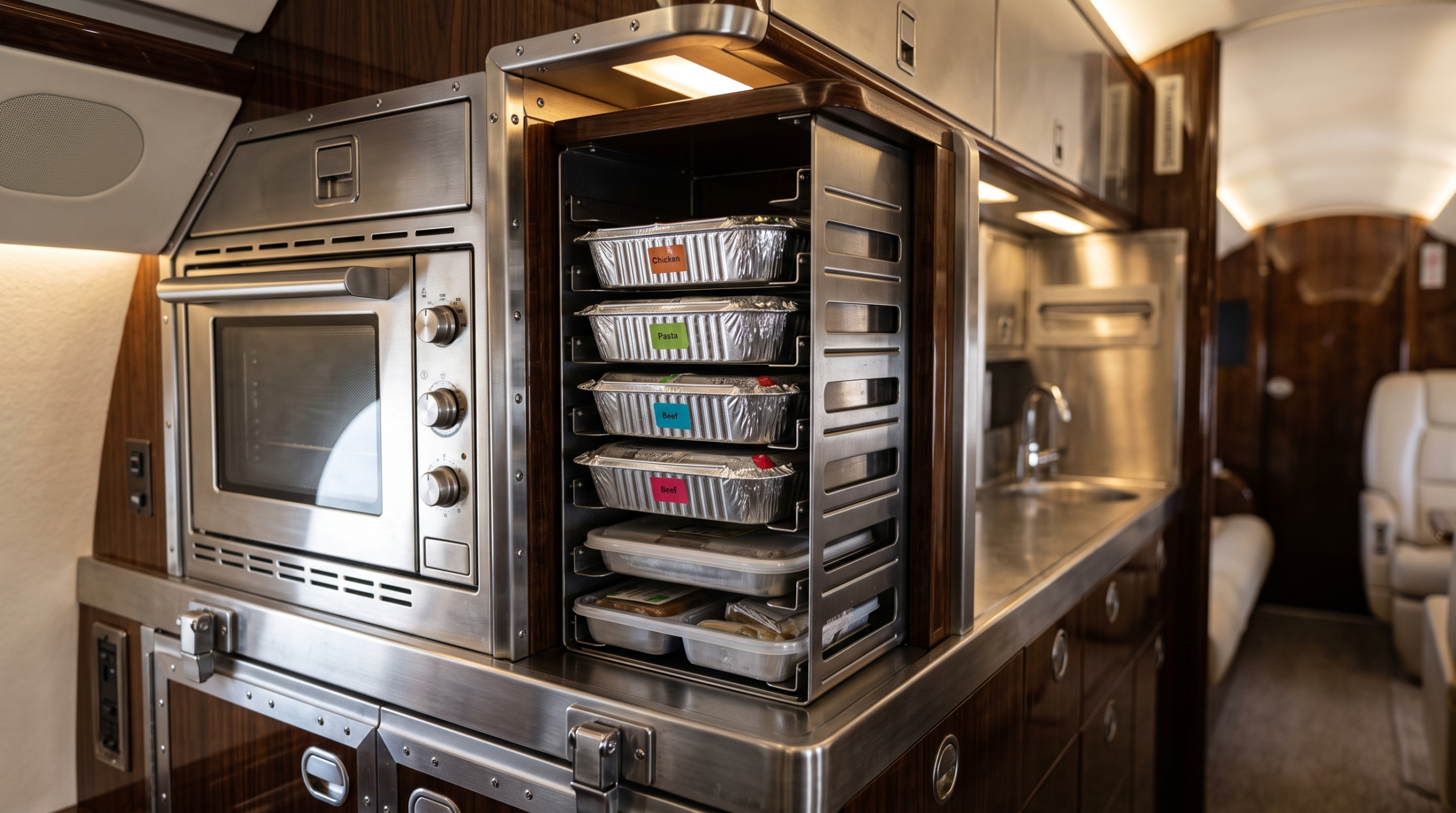
Hot food that reheats without punishment. Not everything reheats. Braised proteins, stews, pasta bakes, and roasted vegetables reheat well in a limited galley. Grilled fish, delicate greens, and anything fried do not.
Portion honesty. Crew meals are routinely under-portioned. A working pilot at hour eight needs a full meal, not a light lunch.
Caffeine and hydration handled properly. Good coffee, plenty of still and sparkling water, and electrolyte options. Cabin air is dry and dehydration is a genuine fatigue driver.
Dietary requirements respected without a conversation every time. If a captain is gluten-free, that should live on the crew profile permanently. Re-explaining it on every order is how mistakes happen. The same discipline that governs passenger dietary restrictions should apply to crew.
How crew meal budgets typically work
Most flight departments handle crew catering one of three ways:
Per-diem reimbursement. The crew buys their own food and expenses it. Cheapest on paper, worst in practice — it consumes crew time on the ground, produces wildly inconsistent nutrition, and generates receipt admin.
Fixed per-crew-member allowance. A set amount per crew member per leg, ordered through the catering provider. This is the most common model and the easiest to forecast. Crew catering allowances in business aviation commonly sit well below passenger service tiers, which is appropriate — the format is simpler, not the quality.
Bundled into the passenger order. Crew meals are added as line items on the same order as passenger catering. Operationally the cleanest, since one delivery covers the whole aircraft and there is one point of coordination against the tail number.
Whichever model you use, the cost drivers are the same ones covered in our guide to private jet catering costs: service tier, lead time, dietary complexity, and delivery logistics.
Timing crew meals against the duty day
The most useful thing a scheduler can do is stop ordering crew meals by leg and start ordering them by duty day.
Pre-departure (show time to wheels-up). Crews are doing preflight, weather, and passenger handling. Food here needs to be immediately edible with no prep. Breakfast items, coffee, fruit.
First cruise segment. Once the cabin is settled, this is the reliable eating window on most trips. The main crew meal should be positioned here.
Ground turn. Often only twenty to forty minutes and consumed by fueling, cleaning, and passenger movement. Plan snacks, not meals.
Long duty days and repositioning legs. On duty days past ten hours, a second crew meal is not a luxury. Repositioning legs with no passengers are often the best window for a proper crew meal.
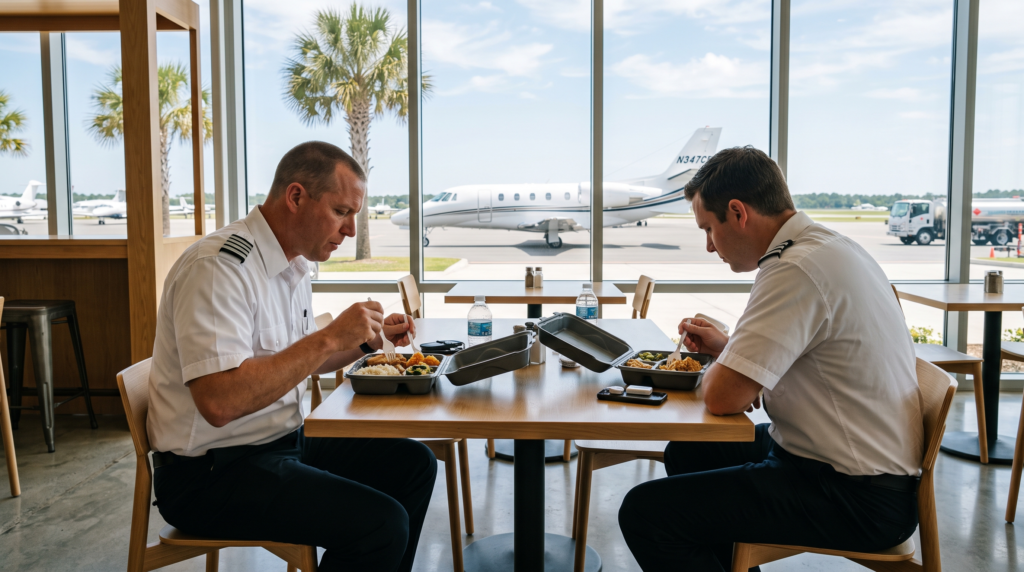
Overnight and early shows. If the crew is on a 4:30 AM show, breakfast has to be pre-positioned the night before or delivered to the FBO before the crew arrives. This is a lead-time coordination question, and it is the one most often missed.
Building a standing crew catering profile
The fix for most crew catering problems is a standing profile rather than a fresh conversation every trip. A complete crew profile records:
Each crew member’s dietary restrictions, allergies, and firm dislikes. Preferred formats — hot versus cold, hand-held versus composed. Coffee and beverage standards. Portion expectations. A four-week rotating menu so no crew member sees the same meal twice in a month. The department’s per-crew allowance. And the aircraft galley spec, because a Citation galley and a Global galley support genuinely different reheat formats — the same principle covered in our piece on packaging for in-flight catering.
Once that profile exists, a crew catering order becomes a one-line request: tail number, date, number of crew, duty day length. Everything else routes itself.
The questions worth asking your catering provider
If you are evaluating a provider for crew catering specifically, ask: Do you maintain crew profiles separately from passenger profiles? Can you run a rotating crew menu without me managing it? What is your earliest FBO delivery window for a pre-dawn show? Which of your hot items are built to reheat in a light-cabin galley? Can crew meals ride on the same delivery as the passenger order? And how do you handle a crew change mid-trip?
Providers who treat crew catering as a real product line will have crisp answers. Providers who treat it as a sandwich tray will not. That distinction is part of why aviation catering is different from restaurant catering in the first place.
Set up your crew catering standard
If your crews are eating whatever the FBO vending machine offers on early shows, or your crew catering line item has been the same tray for three years, it is worth a reset.
Talk to an Inflight Specialist — tell us your fleet, your typical duty days, and your per-crew allowance, and we will build a rotating crew menu and standing crew profiles for your department.
More on the operations side in our pieces on inflight catering services, private jet flight attendant catering, and serving success at 40,000 feet. Duty and rest guidance for the broader operator community is published by the National Business Aviation Association (NBAA).